Jinko 590W 72-Cell Solar Panel (Tiger Neo 72HL4): Complete Guide for Africa and Sudan
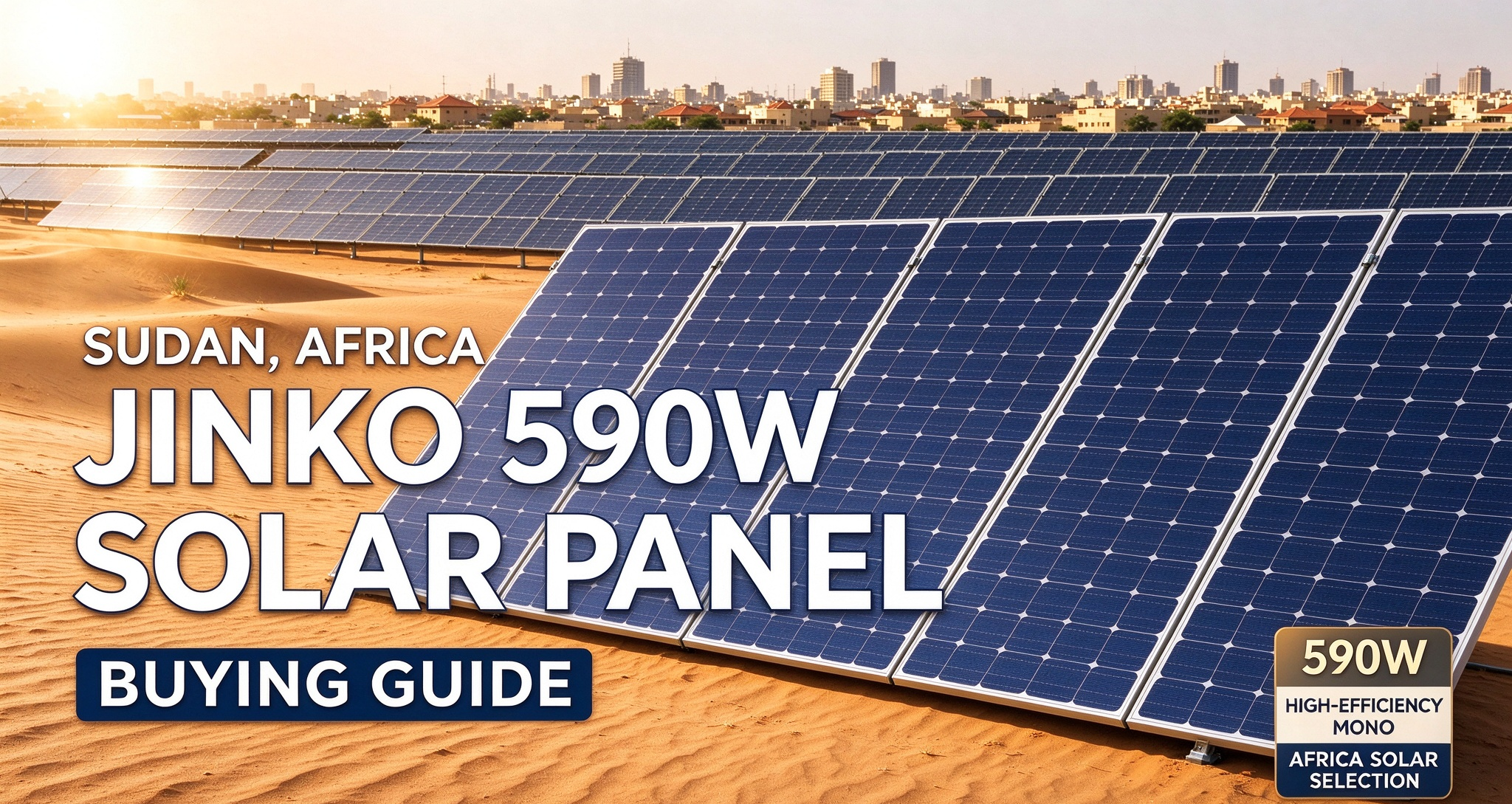
The Jinko Tiger Neo 590W 72-cell module is one of the most practical choices for large commercial and utility solar projects across Africa, and especially in Sudan where grid conditions, extreme heat and dust storms demand proven technology. Unlike oversized 700W+ modules that require expensive racking and transport, the 72HL4 590W fits standard logistics while delivering N-type efficiency and durability.
This guide explains why the 590W 72-cell configuration works for African conditions, what the datasheet tells you about performance in heat and dust, how to size strings for weak grid voltage, and what Sudan buyers need to know about import paperwork, container loading and realistic yield expectations in Khartoum's climate.
All technical data below comes from the official Jinko Tiger Neo 72HL4 datasheets. Yield and cost figures are planning estimates and marked as such.
What "590W 72-Cell" Means
The Tiger Neo 72HL4 uses 144 half-cut N-type cells arranged as 72 × 2. This is the evolution of the classic "72-cell" module format that has been the utility standard for two decades. The 590W bin sits in the middle of the 72HL4 power range (575W to 605W), which means it is widely available, competitively priced, and supported by every major inverter manufacturer's string sizing tools.
Jinko makes two versions of the 72HL4:
- Tiger Neo 72HL4-(V): mono-facial, single glass with backsheet, 580W to 605W, includes 590W bin
- Tiger Neo 72HL4-BDV: bifacial, dual glass, 575W to 600W, includes 590W bin
Both versions include a 590W power bin. The decision between them depends on whether your site has reflective ground surface (white gravel, light-coloured sand, concrete) that justifies the bifacial premium, or whether you prioritise lower weight and cost with the mono-facial version.
Datasheet Specifications at 590W
Tiger Neo 72HL4-(V) 590W (mono-facial)
- Dimensions: 2278 × 1134 × 30 mm
- Weight: 27.5 kg
- Front glass: 3.2 mm low-iron tempered glass with anti-reflection coating
- Backsheet: high-performance composite backsheet
- Maximum power voltage (Vmp): 44.95 V
- Maximum power current (Imp): 13.13 A
- Open-circuit voltage (Voc): 53.75 V
- Short-circuit current (Isc): 13.98 A
- Module efficiency: 22.9%
- Maximum series fuse rating: 30 A
- Temperature coefficient of Pmax: -0.29%/°C
- Temperature coefficient of Voc: -0.24%/°C
- Temperature coefficient of Isc: +0.048%/°C
- Packing: 36 pcs per pallet, 684 pcs per 40'HQ container
Tiger Neo 72HL4-BDV 590W (bifacial)
- Dimensions: 2278 × 1134 × 30 mm
- Weight: 31.0 kg
- Front glass: 2.0 mm with anti-reflection coating
- Back glass: 2.0 mm heat-strengthened glass
- Maximum power voltage (Vmp): 44.85 V
- Maximum power current (Imp): 13.16 A
- Open-circuit voltage (Voc): 53.60 V
- Short-circuit current (Isc): 13.99 A
- Module efficiency: 22.9%
- Bifaciality: 80% ±5%
- Power at BNPI (rear irradiance 135 W/m²): 652W
- Maximum series fuse rating: 35 A
- Temperature coefficient of Pmax: -0.29%/°C
- Temperature coefficient of Voc: -0.24%/°C
- Temperature coefficient of Isc: +0.048%/°C
- Packing: 36 pcs per pallet, 684 pcs per 40'HQ container
Shared Specifications (both versions)
- Cell type: N-type TOPCon monocrystalline with Jinko HOT 3.0 and SMBB
- Power tolerance: 0 to +3% (no negative tolerance)
- Operating temperature: -40°C to +85°C
- Maximum system voltage: 1500 V DC (IEC)
- Junction box: IP68; protection class II; connectors MC4 compatible
- Cables: 4.0 mm², standard lengths 400 mm (+) / 200 mm (-)
- Mechanical load: 5400 Pa front, 2400 Pa rear (static test load)
- Warranty: 15-year product warranty, 30-year linear power warranty
- Degradation: 1% in year one, 0.40% per year after, 87.4% guaranteed at year 30
- Certifications: IEC 61215, IEC 61730, IEC 61701 (salt mist), IEC 62716 (ammonia), IEC 60068-2-68 (sand and dust), IEC 62804 (PID resistance)
Three certifications are directly relevant to Sudan and African conditions: IEC 60068-2-68 confirms the module survives sand and dust storms, IEC 61701 covers salt fog for coastal sites (Port Sudan, Mombasa, Lagos), and IEC 62716 ammonia resistance matters for agricultural or livestock sites.
Why N-Type TOPCon Matters in Sudan and Hot African Climates
Sudan has some of the highest solar irradiation in the world — Khartoum averages 2,500 kWh/m²/year — but also some of the most challenging operating conditions: summer module temperatures regularly exceed 70°C, dust storms (haboob) reduce irradiance and coat panels, and grid voltage fluctuates or drops during peak demand hours.
N-type TOPCon technology addresses the temperature problem directly. Every solar panel loses power as it heats up. The temperature coefficient tells you how much power drops for each degree Celsius above the standard test condition of 25°C.
- Typical P-type PERC module: -0.34% to -0.36%/°C
- Jinko Tiger Neo 72HL4: -0.29%/°C
At a module temperature of 70°C — common in Khartoum, Dongola, Kassala and across the Sahel from May to September — the temperature delta is 45°C above test conditions.
**Power loss at 70°C module temperature:** - P-type PERC (-0.35%/°C): 45°C × 0.35% = 15.75% power loss - N-type TOPCon (-0.29%/°C): 45°C × 0.29% = 13.05% power loss
The N-type module delivers **2.7 percentage points more power** during the hottest hours when electricity demand peaks for air conditioning, refrigeration and water pumping. Over a full year in Sudan, this advantage translates to roughly 3% to 4% more energy yield, which compounds every year for 30 years.
N-type cells also avoid light-induced degradation (LID and LeTID), which is why Jinko guarantees only 1% degradation in year one and 0.40% per year afterwards. Compare this to many P-type modules with 2% first-year loss and 0.55% annual loss. After 25 years, the N-type module retains about 88% of its original power, while a typical P-type module retains about 84%. That 4-point difference is the equivalent of one extra year of full production.
Dust, Sand and Cleaning in African Conditions
The IEC 60068-2-68 sand and dust certification means the Tiger Neo 72HL4 has passed accelerated environmental testing with dust particle injection and abrasion cycles. In practical terms, the module frame drainage holes allow dust to exit, the junction box seal resists fine dust ingress, and the anti-reflection glass coating is hard enough to survive occasional cleaning with brushes or pressurised water.
Sudan experiences seasonal dust storms (haboob) that can deposit several millimetres of fine dust on panels within hours. Dust reduces generation in two ways: it blocks irradiance (soiling loss), and it creates localised shading that can trigger bypass diodes and reduce string voltage.
**Typical soiling loss in Sudan without cleaning:** - Dry season (November to March): 1% to 3% per month - Wet season and transition (April to October): 0.5% to 2% per month, occasional rain provides natural cleaning
**Impact of monthly cleaning vs quarterly cleaning:** - Monthly cleaning: 2% to 4% average annual soiling loss - Quarterly cleaning: 6% to 10% average annual soiling loss - No cleaning: 15% to 25% annual energy loss
For a 1 MW ground-mounted plant producing 1,800 MWh per year, the difference between monthly and quarterly cleaning is about 70 MWh per year, worth approximately $7,000 to $10,000 depending on PPA rate or diesel offset value. The cost of manual cleaning (water truck, labour, brushes) is typically $500 to $1,000 per MW per cleaning, so monthly cleaning pays for itself within two to three months.
**Cleaning method recommendations:** - Use deionised or low-mineral water to avoid residue that attracts more dust - Clean early morning or late afternoon when modules are cool (thermal shock risk if cold water hits hot glass) - Use soft brushes or microfiber mops, avoid abrasive pads - Clean in sections to avoid standing water pooling on arrays - Document soiling loss with monitoring system before and after cleaning to justify cleaning frequency to finance or O&M providers
String Sizing for Weak and Unstable Grids
One of the most common mistakes in African solar projects is oversizing strings for European or Chinese grid conditions, then discovering the system cannot inject power during low-voltage periods or trips offline during voltage sags.
Sudan's national grid (Khartoum, Omdurman, Bahri, Port Sudan) and many regional grids across Africa experience: - Voltage sags of 10% to 20% during peak demand hours - Frequency drift between 49 Hz and 51 Hz - Momentary interruptions (voltage dips to 70% or lower for 0.5 to 2 seconds)
Most modern inverters have a wide MPPT voltage range (e.g., 200V to 1000V or 500V to 1500V) and will continue operating during minor voltage sags, but if the string voltage at high temperature drops too low, the inverter cannot maintain the MPPT operating point and generation falls even though the grid is still connected.
**String design for Sudan conditions (using Jinko 72HL4-(V) 590W):**
Maximum system voltage allowed: 1500V DC Inverter MPPT range (example for Sungrow SG250HX): 500V to 1500V, with optimal range 850V to 1300V
**Temperature-adjusted voltage calculation:**
Lowest expected ambient temperature in Sudan: 5°C (rare, winter nights in northern regions) Highest expected module temperature: 75°C (summer, worst case)
Module Voc at 5°C ambient (assume -10°C temperature rise from ambient to cell): Voc_cold = 53.75V × [1 + (-0.24%/°C) × (5°C - 25°C)] = 53.75V × 1.048 = 56.33V
Module Vmp at 75°C (assume +10°C from ambient to cell, so 85°C cell temperature): Vmp_hot = 44.95V × [1 + (-0.24%/°C) × (85°C - 25°C)] = 44.95V × 0.856 = 38.48V
**String options:**
**26 modules per string:** - Voc at 5°C: 26 × 56.33V = 1,465V (within 1500V system limit, safe margin) - Vmp at 75°C: 26 × 38.48V = 1,000V (at top of optimal MPPT range) - String power at STC: 26 × 590W = 15.34 kW
**24 modules per string:** - Voc at 5°C: 24 × 56.33V = 1,352V (safe margin) - Vmp at 75°C: 24 × 38.48V = 923V (middle of optimal MPPT range, better for weak grid) - String power at STC: 24 × 590W = 14.16 kW
**Recommendation for Sudan and weak-grid sites:** Use 24 modules per string rather than 26. The slightly higher DC/AC ratio is offset by better inverter efficiency at high temperature and lower risk of MPPT dropout during voltage sags. The lower string power also allows better load balancing across inverter MPPT channels.
For grid-tied systems in areas with frequent voltage events, configure the inverter's "low voltage ride-through" (LVRT) settings conservatively: allow the inverter to stay online during sags to 80% of nominal voltage for up to 2 seconds, but trip if voltage drops below 70% or remains low for more than 3 seconds. This prevents inverter damage while maximising energy injection.
Container Loading and Logistics
The Tiger Neo 72HL4 is packed 36 modules per pallet, with 19 pallets per 40-foot high-cube container, for a total of **684 modules per container**. At 590W per module, one container delivers **403 kW** of installed capacity.
**Logistics advantages:** - 684 modules fit comfortably without custom packing or depalleting - Standard EUR or EPAL pallets fit shipping container width exactly - Module dimensions (2278 × 1134 mm) fit standard African racking systems - Weight per container (mono-facial): 684 × 27.5 kg = 18.8 tonnes, well below container payload limit of 26-28 tonnes
**Import requirements for Sudan:**
Sudan Customs requires the following documents for solar module imports (as of 2024, verify with your customs broker): - Commercial invoice with HS code 8541.43 (photovoltaic cells assembled in modules or panels) - Bill of lading or airway bill - Packing list with module serial numbers and datasheet - Certificate of origin (preferably from China Chamber of Commerce for Import and Export of Machinery and Electronic Products, CCCME) - IEC test reports (IEC 61215, IEC 61730) from accredited laboratory - Manufacturer's warranty certificate - Pre-shipment inspection certificate (optional but recommended for large orders)
**Customs duty and taxes (approximate, verify current rates):** - Import duty: 2% to 5% for renewable energy equipment under certain exemptions - VAT: 17% (may be exempt for donor-funded or government energy projects) - Port handling and storage: varies by port (Port Sudan main gateway)
**Lead time from China to Sudan:** - Sea freight Shanghai to Port Sudan: 25 to 35 days - Customs clearance: 5 to 10 days (faster with pre-clearance and complete documentation) - Inland transport Port Sudan to Khartoum: 2 to 3 days (approximately 850 km)
Plan for **6 to 8 weeks** from factory departure to project site delivery.
Real-World Yield Calculation for Khartoum
Khartoum (15.5°N, 32.5°E) is one of the sunniest capital cities in the world, with an annual global horizontal irradiation (GHI) of approximately 2,500 kWh/m²/year and very consistent sun hours year-round. This example calculates the first-year AC energy yield of a 100 kW ground-mounted system using Jinko 72HL4-(V) 590W modules.
**System design:** - Modules: 170 × Jinko 72HL4-(V) 590W = 100.3 kW DC - Inverter: Sungrow SG100CX-P2 or equivalent, 100 kW AC - DC/AC ratio: 1.003 (minimal clipping expected) - String configuration: 24 modules per string × 7 strings = 168 modules; 2 modules spare - Module tilt: 15° (latitude minus 0° for year-round optimisation) - Azimuth: 180° (south-facing) - Ground clearance: 1.5 m (allows rear cleaning access and reduces dust splash) - Racking: fixed tilt, aluminium rails, concrete ballast or ground screws
**Loss assumptions (Khartoum):** - Soiling: 4% annual average (assumes monthly cleaning) - Temperature: calculated based on -0.29%/°C and local ambient temperature profile - Mismatch: 1% (N-type modules have tighter power binning than P-type) - DC wiring: 1.5% (short string runs, 4 mm² cable) - Inverter efficiency: 98.6% (Sungrow SG100CX datasheet, European efficiency) - AC wiring and transformer: 1% - Availability: 99% (grid outages, inverter faults, cleaning downtime) - Degradation year 1: 1% (applies to end-of-year capacity, not mid-year average, so 0.5% effective in first-year calculation)
**Calculation using PVsyst-equivalent method:**
Annual POA (plane-of-array) irradiation at 15° tilt in Khartoum: approximately 2,600 kWh/m²/year
Nominal energy (array DC output at STC): 100.3 kW × (2,600 kWh/m²) / 1 kW/m² = 260,780 kWh/year
Apply losses: - Soiling: 260,780 × 0.96 = 250,349 kWh - Temperature (estimated -9% for Khartoum climate): 250,349 × 0.91 = 227,818 kWh - Mismatch: 227,818 × 0.99 = 225,540 kWh - DC wiring: 225,540 × 0.985 = 222,157 kWh - Inverter: 222,157 × 0.986 = 219,007 kWh - AC wiring: 219,007 × 0.99 = 216,817 kWh - Availability: 216,817 × 0.99 = 214,649 kWh - Year-1 degradation (0.5% effective): 214,649 × 0.995 = 213,576 kWh
**First-year AC energy yield: 213,600 kWh**
**Performance ratio: 213,600 / 260,780 = 81.9%**
This is a realistic PR for a well-designed ground-mounted system in Sudan with monthly cleaning. Without cleaning, expect PR to drop to 72% to 76%. With more aggressive cleaning (twice per month during dust season), PR can reach 84% to 86%.
**Specific yield: 213,600 kWh / 100.3 kW = 2,129 kWh/kW/year**
For comparison: - Germany (Munich, good conditions): 1,100 to 1,200 kWh/kW/year - Spain (Seville): 1,600 to 1,700 kWh/kW/year - Dubai, UAE: 1,800 to 1,900 kWh/kW/year - Khartoum, Sudan: 2,100 to 2,200 kWh/kW/year
**Energy value (example):**
If the system offsets diesel generator fuel at $0.15/kWh (equivalent diesel price ~$1.20/litre including O&M), annual savings = 213,600 kWh × $0.15 = $32,040.
If the system sells to the grid or a PPA at $0.08/kWh, annual revenue = 213,600 × $0.08 = $17,088.
System cost (example, 100 kW turnkey): $65,000 to $75,000 including modules, inverter, racking, installation, grid connection.
**Simple payback:** - Diesel offset: $70,000 / $32,040 = 2.2 years - PPA revenue: $70,000 / $17,088 = 4.1 years
Even with conservative assumptions, the 590W module's higher efficiency and lower degradation justify a premium of 5% to 8% over older P-type technology. The breakeven happens within months, and the cumulative benefit over 25 years is substantial.
Bifacial vs Mono-Facial: Which Version for Your Site?
Both the 72HL4-(V) mono-facial and 72HL4-BDV bifacial versions include the 590W power bin. The bifacial module costs approximately 8% to 12% more per watt but can generate 5% to 25% more energy if the site has reflective ground and adequate rear-side clearance.
**When bifacial makes sense:** - Light-coloured ground surface: white gravel, limestone, light sand, concrete, white painted roofs - Ground clearance 1.5 m or higher (allows reflected light to reach rear side) - Fixed-tilt systems optimised for year-round or summer generation (higher sun angles increase rear-side irradiance) - Sites with space constraints where maximising energy per square metre justifies the cost
**When mono-facial is the better choice:** - Dark soil, asphalt, vegetated ground (low albedo, minimal rear-side gain) - Roof-mounted systems with minimal rear clearance - Budget-sensitive projects where the bifacial premium does not pay back within 3 to 5 years - Sites with heavy dust accumulation (bifacial rear glass requires cleaning for full benefit)
**Bifacial gain calculation for Khartoum ground-mounted site:**
Assume: - Ground albedo: 0.25 (light sand, typical for Sahel and northern Sudan) - Mounting height: 1.5 m at lower edge, 2.3 m at upper edge (15° tilt) - Bifaciality factor: 80%
Bifacial gain (rule-of-thumb): 0.25 albedo × 0.80 bifaciality × rear irradiance factor (0.10 to 0.15 for 1.5m height) = 2% to 3% additional energy
For the 100 kW system example above, bifacial gain = 213,600 kWh × 1.025 = 218,940 kWh, or +5,340 kWh per year.
Bifacial module premium: 100 kW × $0.15/W × 10% = $1,500
Annual benefit: 5,340 kWh × $0.15/kWh = $801
Simple payback: $1,500 / $801 = 1.9 years
**Verdict for most Sudan sites:** Bifacial version (72HL4-BDV) is justified for ground-mounted plants on light soil with proper racking height. Mono-facial version (72HL4-(V)) is better for rooftop systems, budget projects, or sites with dark ground.
Common Mistakes African Buyers Make (and How to Avoid Them)
1. Oversizing strings for cold-climate voltage limits Many buyers copy European string designs with 28 to 30 modules per string, which pushes Voc close to 1500V in cold climates. In Sudan and tropical Africa, this is unnecessary (modules rarely see temperatures below 10°C) and creates a string voltage that is too high for optimal inverter efficiency. Stick to 24 modules per string for 72-cell 590W modules in hot climates.
2. Ignoring cleaning cost in financial models A 1 MW plant in Sudan will lose $15,000 to $25,000 per year in energy revenue without regular cleaning. Budget $6,000 to $12,000 per year for monthly cleaning (water, labour, equipment), and the net benefit is still $9,000 to $13,000. Do not assume "rain will clean the panels" — Sudan's rainy season is short and localised.
3. Using the wrong cable size for high temperatures Many installers use 4 mm² DC cables for strings up to 15 A, which is correct for European temperatures but marginal for Sudan. At 70°C ambient (cable laid on ground or in conduit), 4 mm² cable carrying 13 A has about 2.5% voltage drop over 50 metres. Use 6 mm² cable for string runs longer than 30 metres, or accept 1.5% to 2% additional loss.
4. Not verifying import documents before shipment Sudan Customs will hold a container for weeks if the IEC certificates are missing or if the commercial invoice wattage does not exactly match the datasheet. Request all documents from the supplier before the container leaves China, and have your customs broker review them.
5. Underestimating grid integration requirements Many African grids require expensive protection relays, remote monitoring, and anti-islanding certification before allowing grid injection. Budget $5,000 to $15,000 for grid connection equipment and approval process for a 100 kW system, and allow 4 to 8 weeks for utility approval. Off-grid or microgrid systems avoid this entirely but require battery storage.
Why Choose XinHaoYang for Your Sudan Solar Project?
We supply Jinko Tiger Neo modules directly to buyers across Africa, with specific experience in Sudan's import procedures, grid codes and O&M conditions. We provide:
- **Factory-direct pricing** with transparent cost breakdown (module, shipping, insurance, customs support)
- **Full documentation package** including IEC certificates, origin certificate, warranty letter and datasheet in English and Arabic
- **Container loading supervision** to ensure correct module bins and no transport damage
- **After-sales support** including string design review, inverter compatibility check, and O&M training materials
- **Fast delivery** with regular LCL and FCL shipments to Port Sudan, Djibouti (for onward transport) or Mombasa (for East African cross-border)
Our team has completed projects in Nigeria, Kenya, Ethiopia, Tanzania, Ghana and Sudan, and we understand the practical challenges of African solar: voltage instability, dust, heat, and long distances from technical support. We don't just sell modules — we help you design systems that work.
Contact us for a quotation on the Jinko 590W 72HL4 or to discuss your project requirements. We respond to inquiries within 24 hours and provide detailed technical proposals including string design, inverter recommendations, shipping timeline and total landed cost.
Conclusion
The Jinko Tiger Neo 590W 72-cell module brings N-type efficiency, proven durability and practical sizing to African solar projects. Its -0.29%/°C temperature coefficient delivers 2% to 4% more energy than P-type modules in hot climates, its IEC 60068 sand-and-dust certification is backed by real-world performance in desert and Sahel conditions, and its 684-module container loading optimises logistics cost.
For Sudan buyers, the 72HL4 is the right balance: large enough to minimise balance-of-system cost, small enough to fit standard racking and transport, and efficient enough to justify the N-type premium within the first two years of operation. Choose the mono-facial version for rooftops and budget projects, or the bifacial version for ground-mounted plants on light soil.
If you are planning a solar project in Sudan, whether it is a 50 kW factory roof in Khartoum, a 500 kW agricultural pumping station in Dongola, or a 5 MW grid-connected plant in Port Sudan, start with verified module performance data, realistic yield modeling, and a supplier who understands your market.
**Related products:** - Jinko Tiger Neo 72HL4-(V) 580-605W - Jinko Tiger Neo 72HL4-BDV 575-600W - Jinko Tiger Neo 66HL4M 620W
**Ready to move forward?** Get a detailed quotation with module datasheet, string design, shipping timeline and total landed cost for your Sudan project.
Need help choosing the right solar panels?
Our team can help you find the best solution for your project. Contact us for a free consultation.
Contact Us